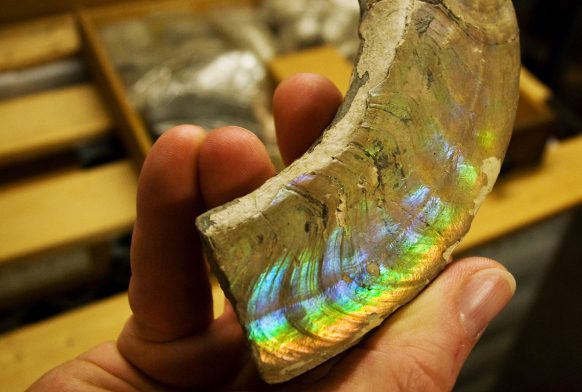
Fragment of mudstone covered in olive-green calicte crust, with radial barite crystals on top.
This is quite an unusual specimen. The disc of crystals on the top is Barite. The green part, although it looks like a rock, is in fact a crust of the mineral calcite, covering a piece of mudstone (which can be seen on the chipped corner). The individual calcite crystals are too small to see without a microscope, but when they build up in masses like this, the formation is called cryptocrystalline.
This object was probably formed as part of a septarian concretion. This is where sediment collects around a nucleus, such as a leaf, large grain, shell or other piece of organic matter, and begins to form a round lump of sediment within a layer, distinct from the material around it. During lithification (i.e., the process that turns loose sediment into a rock), the concretion can crack internally, leaving spaces for minerals to fill when they precipitate from fluids moving through the sediment.